PurpleSeal™ Composite Bridge Plug

BRIDGE THE GAP WITH PURPLESEAL™
PurpleSeal™
The PurpleSeal™ bridge plug is a hybrid-slip “kill” plug that provides temporary wellhead isolation from the zones below after a frac. Our composite bridge plugs are designed with proprietary high-strength material for uniform performance, durability, and industry-leading drill-out.
Unlike a frac plug, which uses a flow-through mandrel and ball to close the plug ID during stimulation, a bridge plug creates a solid internal barrier. PurpleSeal™ bridge plugs are designed to hold pressure from above and below, then allow pressure to equalize before drillout begins.
This lightweight drillable bridge plug comes with a pump-down fin and a patented element backup mechanism to prevent leakage from seal extrusion failures. Interlocking castellations on the slips and end caps, coupled with a planar interface between the slips and cones, keep components from rotating and allow for even slip expansion.
PurpleSeal™ bridging plugs are designed to equalize pressure across the plug before drilling out the upper slip. This helps crews establish the barrier they need without making removal harder than it has to be. Get premium design, high performance, and proven durability, all in one dependable plug.
You might also be interested in:

Benefits of the PurpleSeal™ Composite Bridge Plug
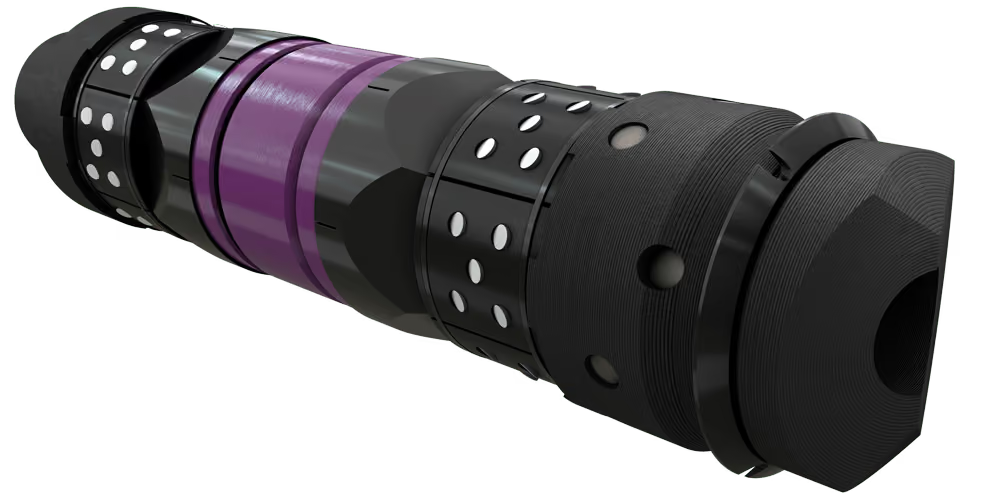
PurpleSeal™ brings the same proven design philosophy from our composite frac plugs to our high‑performance bridge plugs, which are built for temporary isolation and controlled drill‑out.
- Dependable temporary isolation
The PurpleSeal™ bridge plug is built for dependable isolation from zones below the wellhead after frac, protecting your wellbore and surface equipment. - Shorter stage times
PurpleSeal™ composite bridge plugs run at higher speeds to help you get to the next stage faster because of our streamlined design and integrated pump-down fin. - Secure plug placement
Patented element backup mechanisms and a robust slip design help prevent seal extrusion and plug slippage, even in less-than-ideal casing. - Customizable gun string
Run PurpleSeal™ bridge plugs with your current downhole tools, or pair our plugs with PurpleSet™ setting tools and PurpleFire™ perforating guns.
Features of the PurpleSeal™ composite bridge plug
- Rated to 8,000 PSI from below and 10,000 PSI from above
- High-strength composite materials used for internal pressure barriers
- Cast-iron upper slip
- All composite version available with no metal content
- Powder metal buttons in lower slip
- Composite sealing mechanism drills out before upper slips
- Signature purple rubber
How to use it
- Remove the PurpleSeal™ drilling bridge plug from its box.
- Assemble the three-part adapter kit onto the setting tool.
- Insert five or six screws into the plug and adapter kit.
- Start pumping from surface and enjoy the speed limit–free ride!
Frequently Asked Questions

What makes the PurpleSeal™ frac plug different?
The PurpleSeal™ composite plug comes with certain luxuries that other plugs just don’t offer:
- Fully rated top and bottom slips to ensure a strong pack-off
- Built-in rubber element backup system to reduce the risk of rubber flowing during frac and causing plug slippage
- Over 1” of casing engagement by the rubber element when the plug is set
- Flat surfaces on the cones and slips to ensure even casing engagement, smaller debris, and better drill-out
- Fused slips and cones to avoid pre-sets, side damage, and excessive flow rates during pump-down
- Better pump-down than 99% of frac plugs in the oil field
- Best-in-class service that’s built into our plug pricing
Why should I choose a composite frac plug over a plug with a cast iron slip?
Composite plugs are known for being reliable and drilling out easily. They’re also lighter and easier to manufacture than plugs with cast iron slips, which makes them less expensive. In comparison, plugs with cast iron slips are much denser than composite and leave more material behind during drill-out. This can cause plenty of problems, especially with long laterals.
How much does the PurpleSeal™ frac plug weigh?
The weight of a PurpleSeal™ composite plug will vary depending on which size you’re using:
- 480: 16.82 lb
- 455: 13.71 lb
- 438: 12.23 lb
- 360: 7.18 lb
What material are the slip bands on the PurpleSeal™ frac plug?
The slip bands on PurpleSeal™ frac plugs are made from the same material as the mandrel, cone, mule shoe, and other components. These aren’t your grandpa’s frac plugs. You won’t find baling wire or rubber bands here—just thinly wrapped, filament-wound tubes that are precisely machined to break in a pre-determined range of force.
How quickly can I run a PurpleSeal™ frac plug?
PurpleSeal™ composite frac plugs have just one speed limit: not free falling over 400 feet per minute in the vertical or curve. Otherwise, if you want to go fast—and we respect that hustle—we suggest pumping 2–4 barrels per minute to offset the fluid bypass around the plug. We run upwards of 75% of fluid speed with the pump-down fin, while other plugs are more like 40–50%.
- For 5.500” casing applications, keep the pump-down fin on. You should expect 550–650 feet per minute when you’re pumping 18–20 barrels of water per minute.
- For 4.500” casing applications, keep the pump-down fin on. Expect 450–500 feet per minute when you’re pumping 14–16 barrels of water per minute.
In all applications, when you remove the pump-down fin, expect to lose about 50–75 feet per minute.
How fast can I pull the PurpleSeal™ plug out of the hole?
While we love working fast, we recommend pulling out of the hole no faster than 200 feet per minute while the plug is still attached to the BHA.
What is a bridge plug?
A bridge plug is a mechanical barrier installed in the casing to isolate one portion of the wellbore from another. Unlike a conventional frac plug, its internal flow path is closed, so it doesn’t rely on a ball seat to establish full internal isolation.
Why is equalization important?
Drilling into a bridge plug while there’s significant differential pressure across it will create an avoidable operating problem. PurpleSeal bridge plugs are designed so pressure can be equalized across the barrier before the upper anchoring section is drilled away. That gives the crew a controlled transition from barrier in place to barrier being removed.
How is a bridge plug different from a frac plug?
The main difference between a bridge plug vs a frac plug is that a frac plug is normally used between stimulation stages and contains a flow-through mandrel that’s closed with a frac ball. A bridge plug creates a solid barrier through the plug ID and casing ID. That makes it better suited to temporary well control or isolation rather than ordinary stage-by-stage stimulation.
Where can bridge plugs be deployed?
The PurpleSeal™ composite bridge plug is designed to fit into conventional wireline-deployed completions. You can run it with the appropriate adapter and setting tool configuration for the selected plug size and casing program. Compatible applications include:
- Temporary wellhead isolation
- Toe prep applications
- Post-frac wellbore isolation
- Horizontal and extended-reach wells
- Wireline-deployed bridge plug operations
- Applications requiring pressure isolation from above and below
- Planned mechanical drillout after the barrier is no longer needed
Is the PurpleSeal™ bridge plug permanent?
No, it’s designed as a temporary drillable barrier. Once the isolation job is complete, crews can mechanically drill out the plug to regain wellbore access.
How much pressure can the PurpleSeal™ bridge plug hold?
All PurpleSeal™ plugs are rated up to 10,000 psi from above, while the bridge plug is additionally rated to 8,000 psi from below. A bridge plug’s job can require separating lower-zone pressure from the wellhead or work being performed above the barrier, so it needs a different isolation capability from a frac plug that’s primarily loaded by treatment pressure from above.
What makes the PurpleSeal™ bridge plug drillable?
The bridge plug’s high-strength composite construction reduces the amount of dense material that has to be mechanically removed, while interlocking and planar component interfaces help control rotation. The result is a barrier that’s engineered to hold pressure and be removed when the job’s done.
What software pairs with PinPoint?
Use Warrior System with Unifire to pair with PinPoint internal orienting guns.
What addressable switch can I use?
We can configure our systems to run with most wired switches. That said, we recommend using SRS switches due to their communication system, support, and track record of success.
What shaped charge can I use?
Our systems are designed to work with any available charges on the market. For extra convenience, you can get Forcellant power charges delivered along with your PinPoint guns.
What differentiates Repeat Precision’s offerings in the perforating market?
When you work with Repeat Precision, you get the best service in the industry—anytime, anywhere, completely free of charge. Our technical personnel hand-deliver your products to the site for that extra level of attention. And when you have questions, you can always ask the person who knows the answer, whether they designed the system or just delivered it.
What setting tool can I use with your systems?
Our systems are designed to run with all setting tools. We especially recommend disposable setting tools because they expose the bottom hole assembly to a certain amount of force during plug setting.
Do you offer an internally oriented perforating system?
Yes, PinPoint utilizes internal weighting to orient the charge assembly by utilizing gravity.
Why should I choose PinPoint?
Other internal orienting systems struggle with communication due to inconsistent connection caused by weak grounding, usually through the use of bearings, brushes, or grounding springs. Unlike these other systems, PinPoint offers a triple-redundant grounding system that grounds directly to the sub. The precisely machined surface provides the most robust electrical integrity, giving you a better connection.
What makes the PurpleSeal™ frac plug different?
The PurpleSeal™ composite plug comes with certain luxuries that other plugs just don’t offer:
- Fully rated top and bottom slips to ensure a strong pack-off
- Built-in rubber element backup system to reduce the risk of rubber flowing during frac and causing plug slippage
- Over 1” of casing engagement by the rubber element when the plug is set
- Flat surfaces on the cones and slips to ensure even casing engagement, smaller debris, and better drill-out
- Fused slips and cones to avoid pre-sets, side damage, and excessive flow rates during pump-down
- Better pump-down than 99% of frac plugs in the oil field
- Best-in-class service that’s built into our plug pricing
Why should I choose a composite frac plug over a plug with a cast iron slip?
Composite plugs are known for being reliable and drilling out easily. They’re also lighter and easier to manufacture than plugs with cast iron slips, which makes them less expensive. In comparison, plugs with cast iron slips are much denser than composite and leave more material behind during drill-out. This can cause plenty of problems, especially with long laterals.
How much does the PurpleSeal™ frac plug weigh?
The weight of a PurpleSeal™ composite plug will vary depending on which size you’re using:
- 480: 16.82 lb
- 455: 13.71 lb
- 438: 12.23 lb
- 360: 7.18 lb
What material are the slip bands on the PurpleSeal™ frac plug?
The slip bands on PurpleSeal™ frac plugs are made from the same material as the mandrel, cone, mule shoe, and other components. These aren’t your grandpa’s frac plugs. You won’t find baling wire or rubber bands here—just thinly wrapped, filament-wound tubes that are precisely machined to break in a pre-determined range of force.
How quickly can I run a PurpleSeal™ frac plug?
PurpleSeal™ composite frac plugs have just one speed limit: not free falling over 400 feet per minute in the vertical or curve. Otherwise, if you want to go fast—and we respect that hustle—we suggest pumping 2–4 barrels per minute to offset the fluid bypass around the plug. We run upwards of 75% of fluid speed with the pump-down fin, while other plugs are more like 40–50%.
- For 5.500” casing applications, keep the pump-down fin on. You should expect 550–650 feet per minute when you’re pumping 18–20 barrels of water per minute.
- For 4.500” casing applications, keep the pump-down fin on. Expect 450–500 feet per minute when you’re pumping 14–16 barrels of water per minute.
In all applications, when you remove the pump-down fin, expect to lose about 50–75 feet per minute.
How fast can I pull the PurpleSeal™ plug out of the hole?
While we love working fast, we recommend pulling out of the hole no faster than 200 feet per minute while the plug is still attached to the BHA.
What is a bridge plug?
A bridge plug is a mechanical barrier installed in the casing to isolate one portion of the wellbore from another. Unlike a conventional frac plug, its internal flow path is closed, so it doesn’t rely on a ball seat to establish full internal isolation.
Why is equalization important?
Drilling into a bridge plug while there’s significant differential pressure across it will create an avoidable operating problem. PurpleSeal bridge plugs are designed so pressure can be equalized across the barrier before the upper anchoring section is drilled away. That gives the crew a controlled transition from barrier in place to barrier being removed.
How is a bridge plug different from a frac plug?
The main difference between a bridge plug vs a frac plug is that a frac plug is normally used between stimulation stages and contains a flow-through mandrel that’s closed with a frac ball. A bridge plug creates a solid barrier through the plug ID and casing ID. That makes it better suited to temporary well control or isolation rather than ordinary stage-by-stage stimulation.
Where can bridge plugs be deployed?
The PurpleSeal™ composite bridge plug is designed to fit into conventional wireline-deployed completions. You can run it with the appropriate adapter and setting tool configuration for the selected plug size and casing program. Compatible applications include:
- Temporary wellhead isolation
- Toe prep applications
- Post-frac wellbore isolation
- Horizontal and extended-reach wells
- Wireline-deployed bridge plug operations
- Applications requiring pressure isolation from above and below
- Planned mechanical drillout after the barrier is no longer needed
Is the PurpleSeal™ bridge plug permanent?
No, it’s designed as a temporary drillable barrier. Once the isolation job is complete, crews can mechanically drill out the plug to regain wellbore access.
How much pressure can the PurpleSeal™ bridge plug hold?
All PurpleSeal™ plugs are rated up to 10,000 psi from above, while the bridge plug is additionally rated to 8,000 psi from below. A bridge plug’s job can require separating lower-zone pressure from the wellhead or work being performed above the barrier, so it needs a different isolation capability from a frac plug that’s primarily loaded by treatment pressure from above.
What makes the PurpleSeal™ bridge plug drillable?
The bridge plug’s high-strength composite construction reduces the amount of dense material that has to be mechanically removed, while interlocking and planar component interfaces help control rotation. The result is a barrier that’s engineered to hold pressure and be removed when the job’s done.