


The researchers developed a workflow to determine whether isolation issues were developing during fracture stimulation. If successful, this workflow would help future operators predict problems with their isolation without the need for specialized downhole equipment. And identifying issues early means greater efficiency, higher production, and more cost savings.
We know you’re busy, which is why we’ve summed up the study and the workflow in this article. Keep reading and see what this groundbreaking study means for your own completion program.
Project Background
Multiple studies in the frac industry explore issues with casing integrity, plug types, and equipment reliability, which can affect stage isolation and production (White et al 2020, Wardynski et al 2021, Watson et al 2022, Gava et al 2023, Pehlke et al 2024).
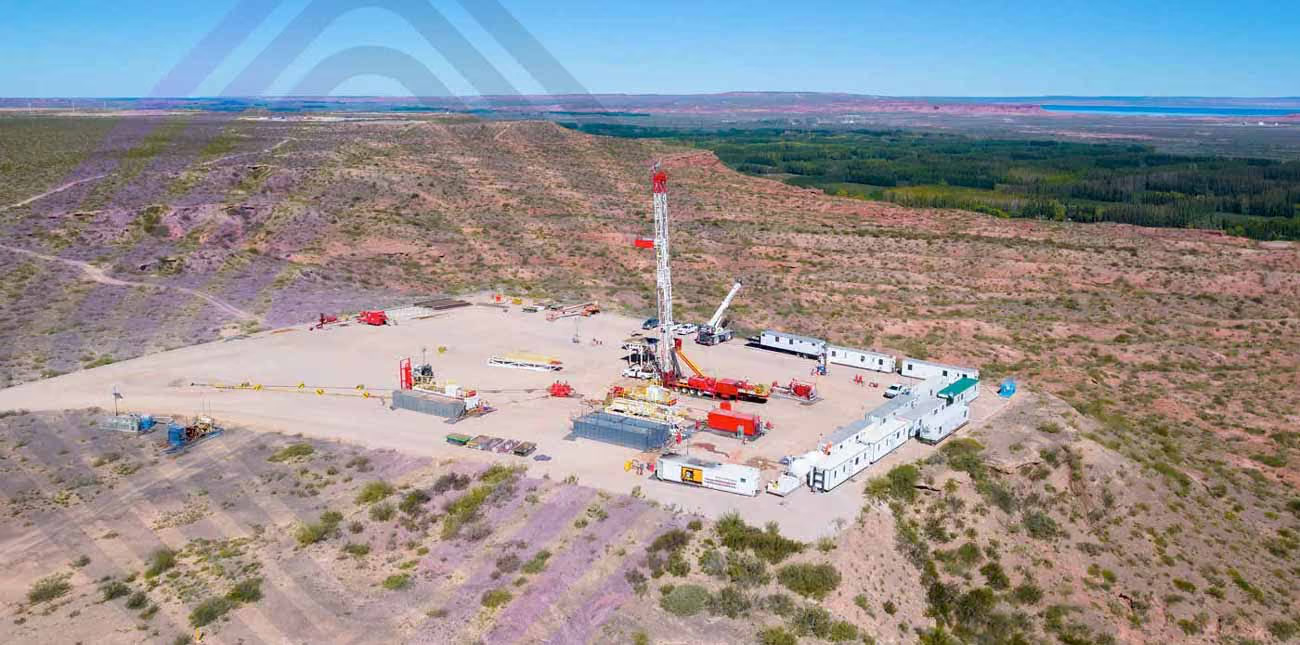
Verrastro et al. conducted the study in the Fortin de Piedra Field in Vaca Muerta, Argentina, one of the world’s largest hydrocarbon deposits. The field is being developed through plug-and-perf zipper fracturing, and most operators are using dissolvable plugs to get around casing deformation.
This study covered 796 plug-and-perf jobs across 27 wells, using 11 different plugs from a variety of vendors. All wells had the same casing and were pumped with the same fluid and proppant mass, volume, and intensities.
READ MORE: What ConocoPhillips learned from their plug testing
Workflow Summary
Verrastro et al. developed a three-stage workflow to identify early plug performance issues. These factors indicate whether a job shows lower treating pressure than expected, which could mean problems with the isolation.
If any of these tests indicate frac plug failure (the plug not setting properly) with a sudden pressure drop, the operator needs to set another plug to depth to achieve isolation. But don’t confuse that with integrity loss, which is an isolation failure not related to plug performance. In that case, it’s best not to pump more plugs after the perforations are shot.
1. Isolation confirmation
The researchers used isolation integrity testing (IIT) to analyze the pressure response of all plug-and-perf jobs included in the test—796, to be exact. This isolation confirmation testing included:
- Pressure behavior during pump down operations and associated leak trend
- Plug pressure test to determine integrity
- Single-cluster leak trend to observe near-wellbore condition
- Single entry point (SEP) test and leak trend
- Cluster shooting for remaining perforations
- Multi entry point (MEP) test with ISIP detection and leak trend
READ MORE: Frac plug forensics: takeaways from DarkVision’s latest report
2. Water hammer cycles
Next, the researchers tracked water hammer cycles during step down rate testing (SDRT). Over 700 SDRTs were conducted throughout the study, and 87 were analyzed closely and compared with the IIT results. The group found that fewer water hammer cycles before dampening indicated high integrity, while more cycles tended to mean integrity loss (or incomplete isolation).
3. Breakdown pressure
Finally, Verrastro et al. compared pressure in the current stage to the pressure in adjacent stages in the same well. Large differences in pressure (600+ psi) could be due to integrity loss, if there aren’t any glaringly obvious reasons for the gap. A sudden pressure drop, on the other hand, pretty much always guarantees plug failure.
In this particular study, the wells used extreme limited entry designs with a nominal entry hole of just 0.41”. This means a high-pressure environment where any changes in integrity are easy to see. Pressure measurements might look different in a well with larger entry points.
READ MORE: Why plug slippage happens (and what to watch out for)
Plug Performance Evaluation
A composite plug was used to complete the first 11 wells in the study. After that point, a pilot project evaluated two types of dissolvable plugs for further completions. The researchers’ frac plug vendor then discontinued the product they were using and offered a shorter plug with a single-slip design.
Due to the range of plug types that the study was using, the researchers created a test protocol to ensure they were seeing the same or better performance from each plug. (And if there were cost savings, even better.) All plug options had to have:
- Zero pre-set incidents during the pump down phase
- Treatment integrity with no more than three consecutive isolation losses or a failure rate of over 30%
- No milling incidents during the well cleanout
The researchers found a few elements in common for plugs that met their requirements, like:
- Robust design
- Two bidirectional slips
- Long sealing elements
- Anti-extrusion systems
- Composite construction
READ MORE: Composite vs dissolvable plugs: which is better?
Workflow Results
Verrastro et al. applied their low-cost workflow to identify jobs at risk of integrity loss with an accuracy rate of 81%. That’s the number of stages showing isolation loss during IIT that also had lower treating pressure in water hammer cycle testing. This is pretty impressive, since analysis was based on pump-down diagnostic data and there wasn’t any specialized equipment involved.
As a result, you can use this workflow to predict issues with zonal isolation in advance and understand past completions.
READ MORE: What makes PurpleSeal™ different?
That’s not all. By combining the workflow with frac plug requirements, the study researchers figured out exactly why an isolation failed, and they were able to identify and remove a bad batch of plugs. How’s that for problem solving?
Looking for a reliable frac plug that’s known for outstanding zonal isolation? Contact us today and learn more about PurpleSeal™ composite frac plugs.
.jpg)
