


It’s Not Your Setting Tool
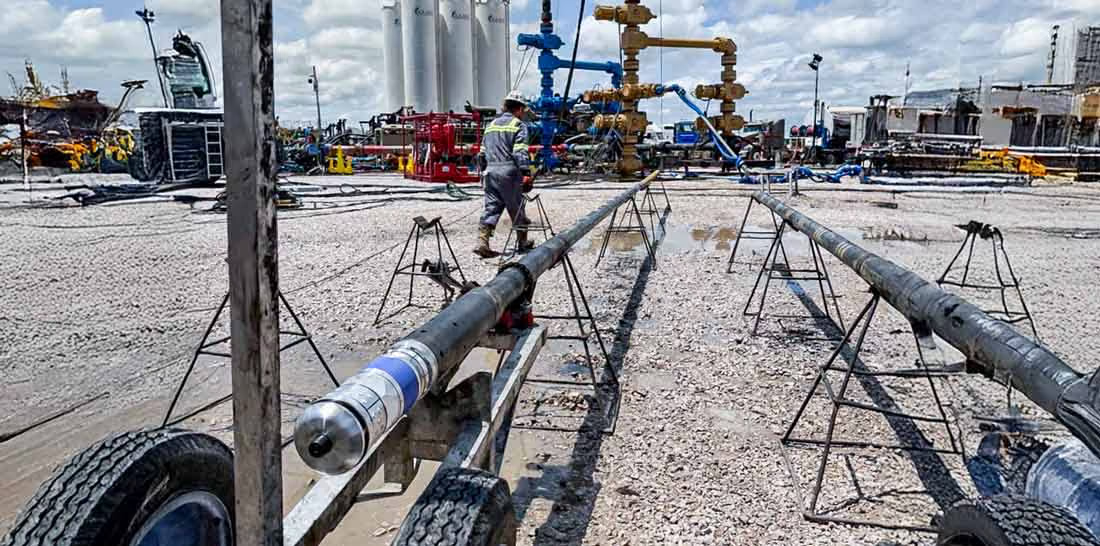
There are two main types of setting tools: conventional and fit-for-purpose.
Conventional setting tools have an oil chamber that dampens the stroke and helps control the speed at which the mandrel moves to set the plug (your stroke rate). This type of setting tool has a long track record of success, so it’s a comfortable choice for many engineers. Some frac plugs on the market were designed with this type of setting tool in mind. But it’s a long, heavy assembly, and it’s not the only acceptable way to deploy a frac plug.
Over the last several years, the market has shifted toward fit‑for‑purpose disposable or single-use setting tools. These tools, in many cases, eliminate the oil chamber and have a more compact design that’s built to run with modern plug assemblies. There are fewer components, meaning less complexity in manufacturing and fewer redress steps in the field, reducing opportunities for error.
Repeat Precision, for example, offers the PurpleSet™ single-use setting tool. It’s designed with greater anti‑preset force to prevent accidental stroking during handling. It has two shear screws instead of one, reducing the risk of a single screw breaking during makeup. Like many modern setting tools, PurpleSet™ has a shorter length that gives you more flexibility with gun spacing and BHA design.
Most disposable tools you see on the market today are similarly designed around the same performance envelope. They’re not exotic outliers—fit-for-purpose is the new baseline, meaning your setting tool probably isn’t the cause if you’re running into problems below surface.
READ MORE: Setting tool compatibility: How Repeat Precision is changing the game
It’s Not Your Power Charge
Any given power charge is likely to get the job done, as long as it can generate enough gas to deliver the required force and stroke in a controlled, predictable way. Burn time helps control certain factors downhole, but it’s not going to affect your plug’s overall performance.
According to our technical sales advisor Evan Blott, “Most disposable setting tools are using the same standard power charge. There are a few off‑brand manufacturers that struggle with issues like consistency and moisture control, but the market knows who they are and avoids them.”
When issues arise with charge manufacturers, they typically trace back to process control, not chemistry or plug compatibility. The real question is whether the charge is being manufactured consistently, and the bigger providers can ensure that consistency. So if you’re running into problems downhole while using the same charges as everyone else, power charge performance likely isn’t to blame.
We’ve done extensive testing on power charge burn times, force and load profiles, charge size, and bottom hole temperature ranges. And we did it with the same standard charge used by most disposable setting tools on the market. It may burn a bit faster than a legacy Baker 20 charge, but it uses less explosive material for a known, field-proven performance profile.
It’s Not Stroke Rate or Impact Loading
Some of the biggest talking points around setting tool and power charge performance are concerns about high stroke rates and high impact. We’ve heard plug companies say these tools and charges are too aggressive, causing plug failures that wouldn’t happen with a slower, dampened stroke.
For Matt Merron, Repeat Precision’s product line manager for frac plugs and setting tools, that doesn’t line up with his 20+ years of engineering experience. As long as the tool can deliver the required stroke length and force, stroke rate within the normal operating envelope shouldn’t be an issue. “There could be a stroke rate that’s too fast for our product,” Matt says, “but I don’t know what that would be. I haven’t come across it yet.”
That’s not to say impact loading is imaginary. It’s real, and we’ve seen it. But we addressed it by designing our PurpleSeal™ composite frac plugs and PurpleReign™ dissolvable frac plugs to tolerate a full range of impact profiles. They’re compatible with all commonly used setting tools and power charges. (But you really can’t go wrong when you combine them with PurpleSet™ single-use setting tools.) Any good-quality frac plug should be able to say the same.
So if your setting tool and power charges aren’t causing plug failures, what’s the real reason? At this point, it really shouldn’t be a surprise.
It’s Probably Your Frac Plug
Most setting tool–related frac plug failures trace back to whether the plug has a repeatable enough performance range to handle real‑world loads throughout the job. At a high level, a frac plug has to anchor firmly in the casing and maintain element compression to keep isolation intact. If it can’t do that, the plug isn’t sensitive to the setting tool—it’s sensitive to the fact that it doesn’t have enough structural margin.
Slips, shear mechanisms, and extrusion limiters are good examples of structural necessities. They’re part of the support structure that keeps your frac plug anchored. If the slips don’t provide enough contact area or the shearing system doesn’t behave predictably under normal field loads, even a normal impact profile can expose that weakness and show up as movement and containment loss.
READ MORE: What do downhole tools mean for your well?
From our standpoint, that’s the heart of the issue. Modern setting tools with standard power charges operate in a fairly narrow and well‑understood envelope. If a plug has enough built‑in support, it should perform consistently across that envelope. When it doesn’t, it’s not because the industry moved to a different tool—it’s because the plug didn’t have enough support to begin with.
To be fair, geology can play a part in why some frac plugs fail. In certain geographies, operators may never see casing deformation, while it’s a weekly headache in others. Casing deformation can be caused by the tubular envelope, improper cementing and isolation, seismic activity or fracturing, or operational practices that push the casing beyond its limits. But if you’re using the right type of frac plug for the job, some minor ovality in the casing doesn’t matter as much as you might think.
Get the Right Plug For the Job
Our president Grant Martin sums it up best: “A plug should perform the same no matter what setting tool and power charge you use, as long as there’s enough force to set it. If your plug provider is blaming performance on the setting tool, you should be looking hard at the plug design, not your BHA. And you should run the other way.”
Modern disposable setting tools and standard power charges are proven, widely used technologies that deliver real operational benefits. If your frac plug provider is saying that performance depends on avoiding certain tools or charges that everyone else is running successfully, it’s worth asking why. Your plug shouldn’t dictate your setting tool. Your setting tool should simply deliver the force—and your plug should do the rest.
We designed and engineered PurpleSeal™ frac plugs to run on the same tools and charges the rest of the industry uses. But because we like doing things better than everyone else, we also developed the PurpleSet™ setting tools to help streamline your operation. Talk to us and add our downhole tools to your next run.
.jpg)